
Have you ever felt like your daily job gets harder when your company hires more people? You might think that more hands on deck would make a shift easier. However, adding more people just adds more noise, confusing chat messages, and messy handoffs. Without proper systems which are built to accommodate, your frontline teams will simply scale disorder.
When a company grows without a plan, the frontline teams have to keep adjusting processes which affects consistency of delivery. The importance of systems that promote scaling order is captured quite well in this quote by James Clear, the author of Atomic Habits: “You do not rise to the level of your goals. You fall to the level of your systems.” (checkout how systems protect your workday on the James Clear Systems Page). This means that even though you hire the best talent, their productivity will always be limited by the culture and systems they find themselves in.
“You do not rise to the level of your goals. You fall to the level of your systems.” James Clear, the author of Atomic Habits
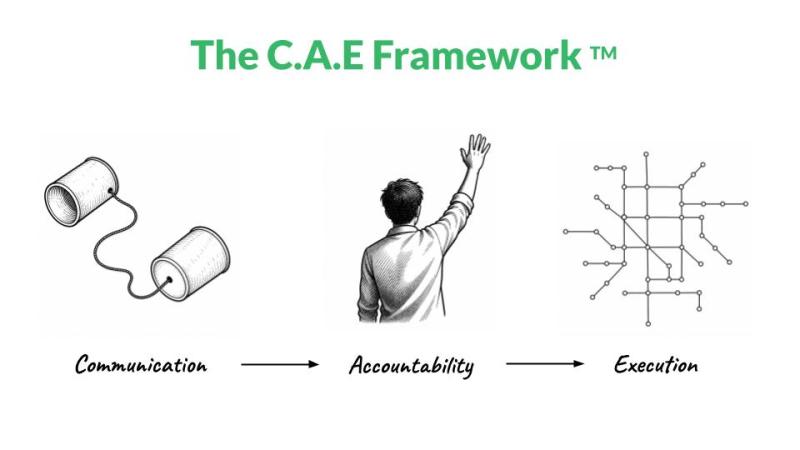
The good thing is that if a team can remove ambiguity from these three areas captured in the CAE Framework they will build more resilient sytems that are setup to accommodate more people and scale order. The inverse is sadly true that if any 2 of the areas defined in the CAE framework have a lot of ambiguity, the team is setting itself to scale disorder.
What is the CAE Framework?
The CAE Framework is a tool designed to remove ambiguity and build clarity in three main areas:
- C stands for Communication – your information system.
- A stands for Accountability – your ownership system.
- E stands for Execution – your delivery system.
It’s important to note that the order in which the framework is arranged in is quite intentional. If the first 2 areas(Communication and Accountability) don’t work, they will affect how Execution happens.
Step 1: Build a Clear Communication System
Communication is how ideas and data move through your frontline teams. To create an information system that allows ideas to flow freely, simply focus on these three areas:
- Keep your team size manageable: When a team grows, the lines of communication grow even faster and the problem of Communication Complexity becomes compounded. This is based on Metcalfe’s Law, which shows how networks get more complex as they grow. A decent rule of thumb with this law in mind is that if a team grows larger than six people, you should split it into smaller groups. At six people, you already have 15 different lines of communication to manage!
- Share Knowledge in One Place: Do not let your team rely on the “ask someone” method. When you reach 8 to 10 people, that method stops working. The key is to Create a central knowledge hub or central store for Standard Operating Procedures (SOPs) using Google Docs, Notion or even Frontline Training platforms like tizisha which allow you to build micro learning around your SOPs and track consumption. Common questions that every hire asks should be pointing to a written document and not a person.
- Have Purposeful Discussions: Stop having random meetings that cover the same things. Instead, have a small set of lightweight predictable ceremonies. Use short daily standups to talk about what is next and what is blocked. Use 45-minute retrospective meetings to look back at the week and see how to improve. Use all-hands meetings only for big strategies and updates, not for solving small problems. The key isn’t to meet for the sake of meeting but sticking to the purpose of a meeting.
Step 2: Create a Strong Accountability System
Accountability is your ownership system. It builds trust because people know that when someone promises to do a task, it will get done. Focus on these three things to build an ambiguity free ownership system.
- Define Ownership: Structure your frontline teams into account units where every small team needs to know exactly what they are responsible for. When teams see a coherent area as “theirs,” trust, commitment, and team efficacy go up, which in turn predicts performance and sustained accountability. Once you have those teams, setup create a simple document called a RACI matrix. This matrix lists who is Responsible, Accountable, Consulted, and Informed for each task. Check out the Cornell University RACI Definitions to learn how to set one up.
- Build Psychological Safety: High accountability should never mean high blame. People must feel safe to admit their mistakes so the team can fix them. During review meetings, do not ask “who messed up?”. Instead, ask “what did we learn?”. Use the “5 Whys” method to find the root cause of a problem.
- Make Goals Clear: Get accountability expectations from the place of assumption to a place that’s visible. This applies at three levels: company, team, and individual. You can use a system called OKRs, which stands for Objectives and Key Results where each key result has a clear owner and measurable target, and is transparently visible. For deeper integration, implement rhythmic check‑ins (weekly team reviews, monthly 1:1s) where the owner reports progress, blockers, and learning; others give feedback and help, but the owner speaks first. To understand how OKRs work, you can visit the IBM OKR Guide.
Step 3: Smooth Out Your Execution System
Execution is your delivery engine, the place where value is delivered. This is where the actual doing happens.
- Make Work Visible: If work is hidden, it gets ignored. Use a physical tracking board, an Excel sheet or digital task management system so everyone can see what is in progress, what is pending, and what is blocked.
- Make Processes Repeatable: If you have too much variance in your frontline teams ability to execute consistently, quality will drop significantly. Aim to have 80% of your core processes written down so anyone can repeat them. This keeps training costs low and stops quality from crashing when a new person joins.
- Standardize Outcomes: Write down what a “good outcome” looks like for every role. Define what is bad, what is average, and what goes above expectations. This removes confusion and helps you make better hiring decisions later. A simple way to extract this is by creating an Employee Competence Journey map.
By following these steps and using the CAE Framework, you can stop scaling disorder in your frontline teams scaling and enjoy smooth, organized growth. Checkout the full webinar below where these concepts were discussed